+8615061447755

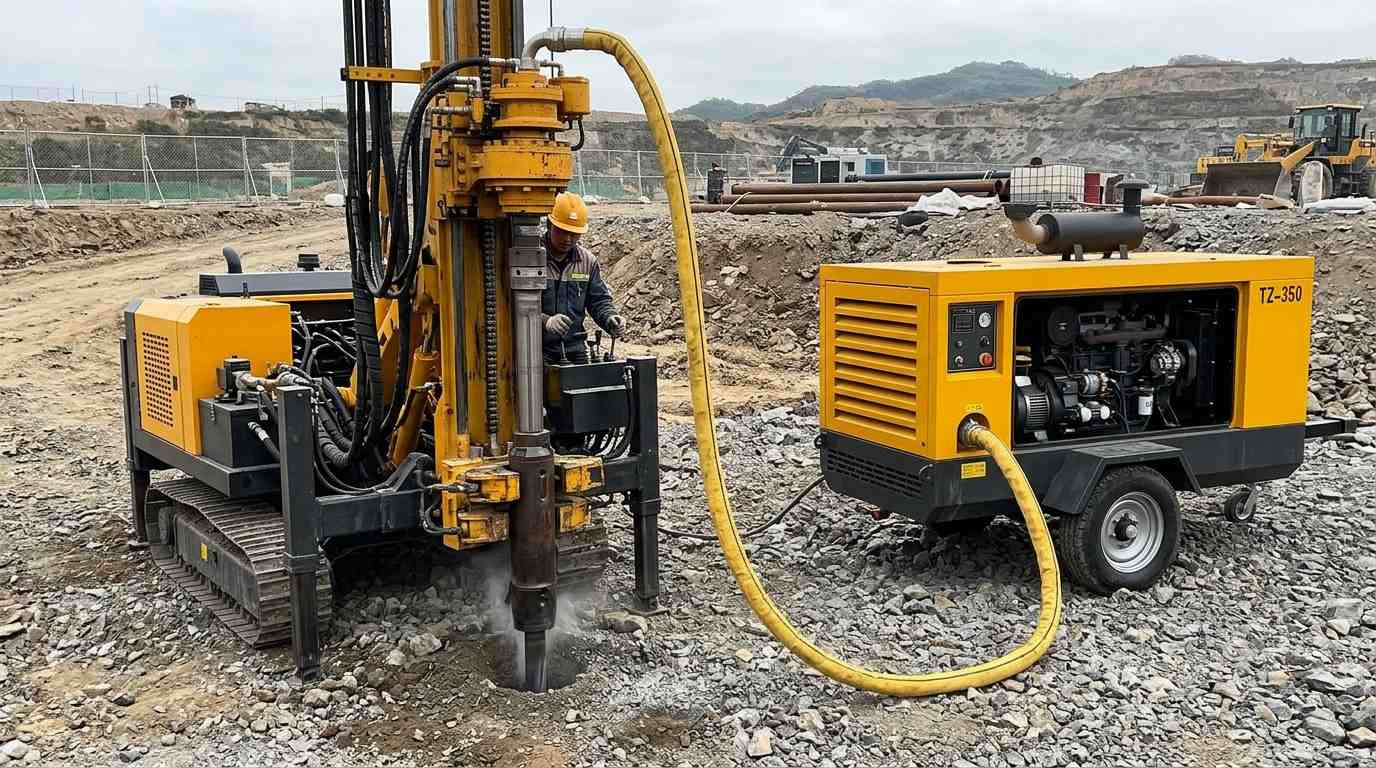
A down-the-hole hammer needs compressed air at the bit to strike and to clear cuttings, and the compressor is the half of the system that decides whether the rig holds its pace. Across six machines the stated demand runs from 10–15 m³/min at 0.8–1.6 MPa on the smallest separated rig to 14–50 m³/min at 1.0–2.4 MPa on the largest, while one integrated unit carries its own two-stage compressor delivering 25 m³/min at 13 bar. Anhui TeZhong Machinery Technology Co., Ltd. builds both the drilling machines and a separate diesel screw compressor line, so the pair can be quoted together. Our compressed-air down-the-hole drilling machine range covers separated units that take air from an external set and one self-contained machine. As a direct manufacturer and OEM supplier, we would rather match the air supply to the hammer than to the engine on the data sheet.
Five of the six machines take air from an external compressor: demand spans 10–15, 10–18, 11–21, 14–35 and 14–50 m³/min, at working pressures from 0.7–1.8 MPa to 1.0–2.4 MPa. The sixth, the TZ849, carries its own two-stage compressor at 25 m³/min and 13 bar. Our diesel screw compressor line is listed at 110–1200 cfm, so the range covers most of those demands, but the two sets of figures use different units and must be reconciled on the configuration sheet. Anhui TeZhong Machinery Technology Co., Ltd. supplies the rig, the compressor or both, and states which hammer each air package was selected for.
|
10–50 m³/min
Air demand across six machines
|
0.7–2.4 MPa
Working pressure range
|
110–1200 cfm
Listed compressor line
|
25 m³/min
On board, one model at 13 bar
|
The air figure is printed as a range because a hammer does not draw the same flow at every hole diameter and depth. The smallest machine is rated 10–15 m³/min; the largest separated unit 14–50 m³/min. Between them sit 10–18, 11–21 and 14–35 m³/min. Specifying to the bottom of a range saves fuel but leaves the hammer short when the hole gets bigger or the cuttings column gets longer.
| Machine | Air demand | Working pressure | Hammer | Air supply |
|---|---|---|---|---|
| TZ612 | 10–15 m³/min | 0.8–1.6 MPa | 3"/4" | External |
| TZ712 | 10–18 m³/min | 0.7–1.8 MPa | 3"/4" | External |
| TZ729 | 11–21 m³/min | 1.0–2.0 MPa | 4"/5"/6" | External |
| TZ720 | 14–35 m³/min | 1.0–2.4 MPa | 4"–8" | External |
| TZ750 | 14–50 m³/min | 1.0–2.4 MPa | 6"–12" | External |
| TZ849 | 25 m³/min | 13 bar, on board | — | Own compressor |
Under-size the supply and the hammer still turns, just slower, with more fines left in the hole. That is the failure mode we see most often: the rig is blamed, the compressor is never measured, and the crew loses time clearing a hole that never got clean.
Volume keeps the hole clean; pressure is what lets the hammer deliver its blow at depth. The five separated machines are listed between 0.7–1.8 MPa and 1.0–2.4 MPa depending on model. The integrated unit publishes its supply as 13 bar from a two-stage compressor. A compressor that matches on volume but cannot hold pressure at the far end of the hose is still the wrong machine.
Ask for pressure at the hammer, not only at the compressor outlet, and account for the hose run between them. On a bench where the rig moves often, a long hose is convenient; on a deep hole it is a pressure loss you pay for on every metre.
Hole diameter follows the hammer, and air demand follows both. A 3"/4" hammer covers the 90–140 mm machines on 10–18 m³/min. A 4"/5"/6" hammer covers 115–180 mm on 11–21 m³/min. The 4"–8" class runs 160–300 mm on 14–35 m³/min, and the 6"–12" class runs 260–500 mm on 14–50 m³/min. Those pairings are why a compressor cannot be chosen from drilling depth alone.
Drill rods are the other half of the match: φ60, φ64, φ76 and φ89/102 are four different strings, and the largest one is paired with the widest holes. Tell us the hammer class and the rods already on site before asking for a compressor quote.
Numerically, yes — if the summed demand stays inside the supply. Two small rigs at 10–15 m³/min each need 20–30 m³/min combined; one machine at 14–50 m³/min can use the whole output of a large set on its own. Those are additions of the published figures, not a measured share-out on a live bench.
What the arithmetic does not show is simultaneous operation. Two hammers rarely strike in phase, and a hose network has losses. A site with a fixed air station and several drills is a reasonable case for a shared set; a crew that moves between benches every shift is not. Where the work also involves piling, a highway guardrail driving unit does not draw hammer air at all, so it can keep working while the drilling set is committed elsewhere.
One model in the range removes the separate compressor entirely. It carries a two-stage compressor delivering 25 m³/min at 13 bar, driven by a 228 kW Yuchai National III engine with a 400 L fuel tank, IP56-rated electrics and a 14-core dust collector. The whole unit is 8,800 × 2,300 × 2,600 mm. There is no second engine to position, no hose to lay and no compressor to schedule.
That convenience has a limit: 25 m³/min is a single figure, not a range up to 50. A job needing the widest holes still points to a separated rig with a larger external set. The same trade-off appears in piling equipment — a solar pile driving platform carrying its own power pack moves faster between rows, while a site with a fixed plant can run more tools from one source.
Dust and heat are air-system problems as much as drilling problems. On machines built for high-temperature, dusty conditions, fasteners were upgraded from M10 to M12 and the dust discharge openings were enlarged; the compressor and filtration package has to survive the same environment as the hammer. A set that performs on a temperate site can overheat or choke on a desert bench if it was not specified for that air.
Ask which filtration and cooling package is fitted, and whether the compressor is rated for the ambient temperature on your site. We would rather fit the wrong-looking machine with the right package than send a standard set into dust and wait for it to fail.
Rig air demand is published in cubic metres per minute; the compressor line is published in cfm, from 110 to 1200. Both describe volume, but they are different units, and a quotation that leaves them unconverted invites a mismatched pair. Put both figures on the same line of the configuration sheet with the conversion shown, then confirm the delivered flow at the hammer.
The same applies to pressure: MPa on one sheet, bar on the other. The integrated unit's 13 bar is written that way in its specification; the separated machines use MPa. None of that is a contradiction, but it does have to be written down before the order is signed.
Six items. As a factory and OEM supplier we can combine a rig, a compressor and a hammer package, but only after the hole and the air path are defined:
| Item | What it fixes |
|---|---|
| Hole diameter and hammer class | 3"/4", 4"/5"/6", 4"–8" or 6"–12" |
| Required depth and drill string | φ60, φ64, φ76 or φ89/102 rods |
| Air demand and pressure at the hammer | 10–50 m³/min and 0.7–2.4 MPa, or on-board 25 m³/min at 13 bar |
| One rig or a shared air station | Whether demands can be added inside one supply |
| Hose length and site ambient conditions | Pressure loss, filtration and cooling package |
| Emission standard for both engines | Yuchai National II / III options and the compressor's own engine |
Send those and we will answer with a model, the matching air package and a written configuration sheet. One customer in Qatar specified a hammer top plate, bottom bracket, auger, down-the-hole package and compressor together — the pair was built as one order rather than matched on arrival. That is how we would rather do it.
How big a compressor does a 6"–12" hammer need?
The machine paired with that hammer class is rated 14–50 m³/min at 1.0–2.4 MPa. Size the supply to the top of the range you actually plan to drill, not to the smallest hole on the drawing, and confirm the flow at the bit.
Does any machine come with its own air supply?
Yes. One integrated model carries a two-stage compressor at 25 m³/min and 13 bar, driven by a 228 kW engine. The other five take air from an external compressor.
Can cfm and m³/min be compared directly?
No. They measure the same thing in different units. Our rig figures are in m³/min and the compressor line is listed at 110–1200 cfm, so the conversion has to be written on the configuration sheet along with the pressure, which is quoted in MPa on some machines and bar on another.



+8615061447755
 IPv6 network supported
Our hours
Whether it is a holiday or a festival, we will have someone to receive you 24 hours a day and respond to you in the shortest time.
Hi! Click one of our members below to chat on