+8615061447755

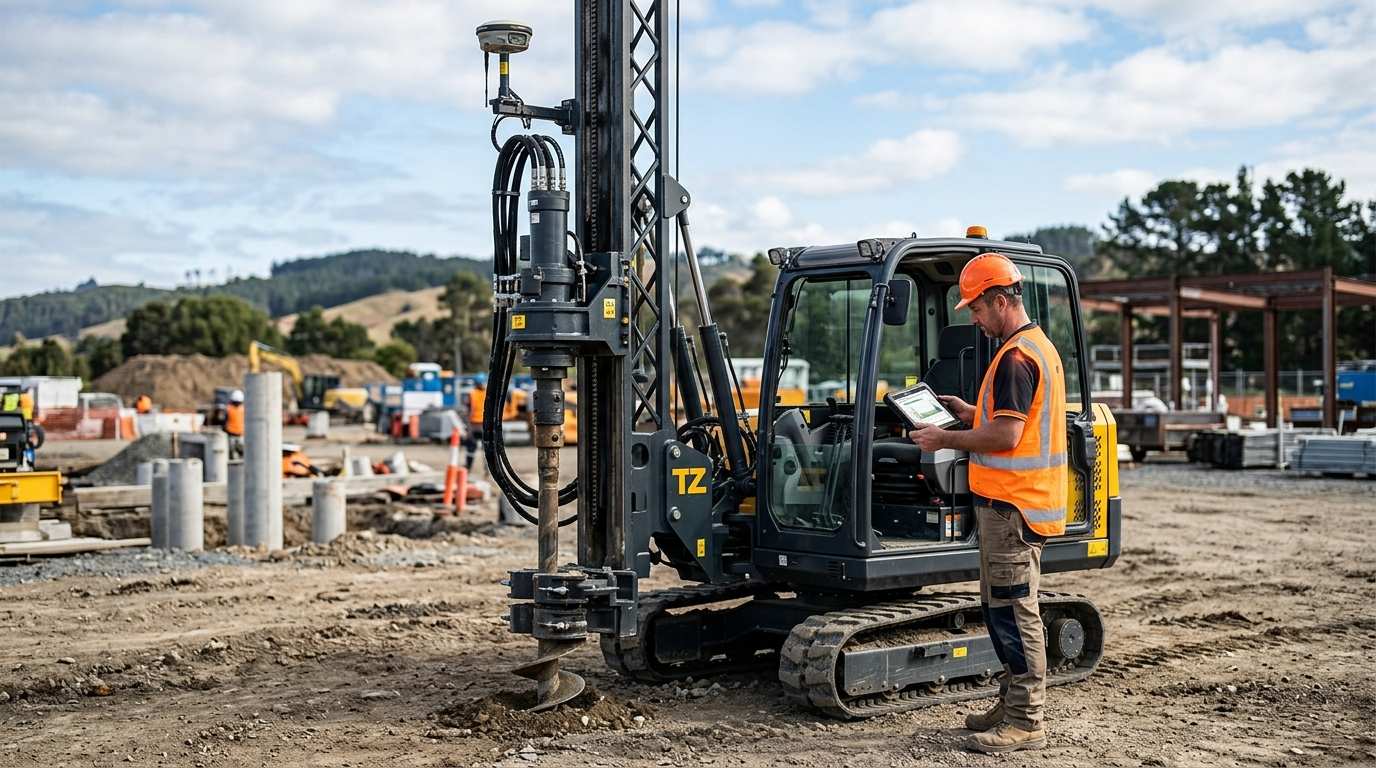
Anhui TeZhong Machinery Technology Co., Ltd. builds piling machines whose automated functions can be specified down to the sensor: the TZ650 crawler runs a Cummins 75 kW engine, carries two attitude sensors, three rope displacement sensors and one rotary encoder, and returns its mast to vertical with one button. Its GNSS base station covers 3 km and receives four satellite systems — GPS, GLONASS, GALILEO and BeiDou — while custom remote-control packages on shipped units work at distances of about 100 m. Those are configured functions, not a driverless site: one operator can run the piling cycle, but setting out, pile handling and ground preparation still need a crew. Our solar farm foundation rig range includes both the automated crawler and conventional machines. As a direct manufacturer and OEM supplier in Suzhou, Anhui, we would rather state the boundary plainly.
Automation on these machines covers walking, navigation alignment, mast straightening and resetting, pile hanging and piling, executed by a control terminal that reads the sensors and drives the sequence. The TZ650 adds a tablet linked by Wi-Fi, an app for parameters and status, and an auxiliary remote; one person can complete the piling task. GNSS coverage is 3 km from the machine-mounted base station, with four satellite systems available. The system does not replace survey control, ground preparation or the decision to pre-drill hard rock. Anhui TeZhong Machinery Technology Co., Ltd. builds the chassis and the control package together.
|
3 km
GNSS base station coverage
|
~100 m
Configured remote-control range
|
1 operator
Complete piling cycle
|
75 kW
Cummins engine, TZ650
|
The TZ650 control system combines automatic walking, navigation and automatic pile driving. A tablet connects to the control terminal over Wi-Fi; the terminal reads the sensors and carries out seven actions — drill arm resetting, slide frame straightening, slide frame resetting, walking, navigation alignment, pile hanging and piling. The system supports two working modes, hammer head and rotary head, so one chassis can strike or bore without changing carrier. If the tablet is awkward on a given row, an auxiliary remote takes over.
That is the honest scope of "fully automatic" here: the machine executes a commanded sequence. It does not choose the row, check the setting-out, or decide what to do when the ground changes between piles.
Remote-control packages are a configured option across the range. On the TZ539, all operations can be completed from the remote at about 100 m. The TZ536 and TZ8000 are also listed with remote equipment for moving efficiently between piles and between rows. A customer in Italy ordered two TZ536 units built to 6.0 m driving height instead of the standard 5.5 m, with 91 kW YuChai Euro Stage V engines, a winch, a 100 m remote and a one-button auto-levelling mast. None of those items arrived as a software update; they were built into the machines before shipment.
The machine carries its own GNSS signal base station, providing a radio reference and coordinate position with a coverage radius of 3 km. Operators can receive GPS, GLONASS, GALILEO and BeiDou, choosing the satellite systems the job needs. The right differential mode and parameters still have to be set for high-precision positioning.
A 3 km radius covers a large PV block, but coverage is not the same as accuracy at the far edge. Site conditions and the chosen differential mode still matter. We would rather you confirm the coordinate on the first row than find the drift on the last one.
The levelling system uses two built-in attitude sensors to monitor and adjust the working state, three rope displacement sensors to read horizontal and vertical mast extension, and a rotary encoder. One button returns the mast to vertical. That matters because a post driven off-plumb is scrap metal and a re-drilled hole.
On the TZ650 that system sits on a rubber-track chassis rather than steel tracks, reducing machine weight, damage to the surface and operating noise. Useful on finished roads and on PV rows where the ground has already been graded.
One person can complete all the piling construction tasks on the TZ650. That is a real reduction in crew size, and it is why the chassis is sold into both PV and road-safety work. The tablet handles parameters, progress and equipment status; the remote handles the rest.
One operator is not one site. Someone still has to set out the row, supply the posts, keep the machine fuelled and check the first few holes. We do not quote a posts-per-shift figure from a headcount alone — the ground decides that number, not the number of people in the cab.
Where the boundary sits depends on the ground. A machine can align, drive and count; it cannot decide that the layer under row four has changed from soil to boulder.
| Task | Machine handles | Crew still handles |
|---|---|---|
| Alignment and mast verticality | GNSS navigation, sensor-based one-button reset | Check setting-out against the site grid |
| Driving the post | Automatic piling sequence, hammer or rotary mode | Choose the attachment, inspect the first post |
| Moving between positions | Automatic walking and navigation alignment | Clear the route and mark obstacles |
| Hard rock or boulders | Rotary or auger mode where fitted | Decide to pre-drill; call a deeper rig past the hole limit |
| Quality and records | Sensor feedback and app status | Measure plumb and depth, sign off the row |
When pre-drilling goes deeper than a PV or roadside machine can reach, the work belongs to DTH drilling equipment rated to 30, 35 and 50 m with 90–500 mm holes. Automation changes who holds the remote; it does not change the geology.
Paint, decals, remote-control packages and attachments are configuration work; engines, masts and hammer arrangements are engineering work and affect lead time. The TZ536 is listed at 30 working days, the TZ390 at 7 working days, and monthly capacity is 500 machines. The Italian order moved the driving height from 5.5 m to 6.0 m, fitted 91 kW Euro V engines, a winch and a 100 m remote, and left Qingdao Port on the agreed date.
Ask for the function on the configuration sheet, not the marketing word "intelligent". Remote range, a GNSS base station and an automatic levelling package are three separate line items, and each can be quoted or left off.
| Question to answer | Why it changes the build |
|---|---|
| Driving height and pile diameter | 5.5 m standard or 6.0 m custom on the TZ536; 50–400 mm holes |
| GNSS guidance, or remote control only | 3 km base station and four satellite systems are a distinct package |
| Operator count and rows per shift | One-person piling cycle; layout and handling remain on site |
| Ground profile, including rock | Decides hammer, rotary head or pre-drilling |
| Emission standard and engine | 91 kW Euro V was specified for the Italian units |
For crews that also run barrier lines, the same automated chassis crosses over: a roadside barrier post driver follows the same logic of repeatable spacing and plumb posts. Our engineers will answer with a configuration sheet that lists the control package line by line.
How far can the remote control work?
Custom packages on shipped units are specified at about 100 m, and the TZ539 supports all operations from the remote at roughly that distance. Remote range is a configuration item, not a property of every machine.
Does one operator mean one person for the whole site?
No. One person can complete the piling task on the TZ650. Setting out, pile supply, refuelling and checking the first holes still need a site crew.
What does the GNSS package actually include?
A machine-mounted base station with 3 km signal coverage and a choice of four satellite systems: GPS, GLONASS, GALILEO and BeiDou. The operator still selects the differential mode and sets the parameters for the accuracy required.



+8615061447755
 IPv6 network supported
Our hours
Whether it is a holiday or a festival, we will have someone to receive you 24 hours a day and respond to you in the shortest time.
Hi! Click one of our members below to chat on