+8615061447755

A customer sent us a drawing last year with one line highlighted: 8 m piles. He had already asked several factories and had not found a machine that would take them. We extended the guide rail to 8.5 m, fitted a Cummins engine to meet Euro 5, and the machine was tested before it left for Russia in July 2024. That job is the reason we now answer pile-height questions before we talk about engines, hydraulics or price. On our own product pages the standard range runs from 4.0 m on the TZ585 up to 8.0 m on the TZ8000, and the model that fits a 4 m post is not the same machine that fits an 8 m one. This article is how we work it out, using the specification tables published on tzpilemachine.com — no brochure estimates, just the figures our engineers quote from. If you are comparing a solar foundation driving machine for a specific PV project, start with the pile length and read down.
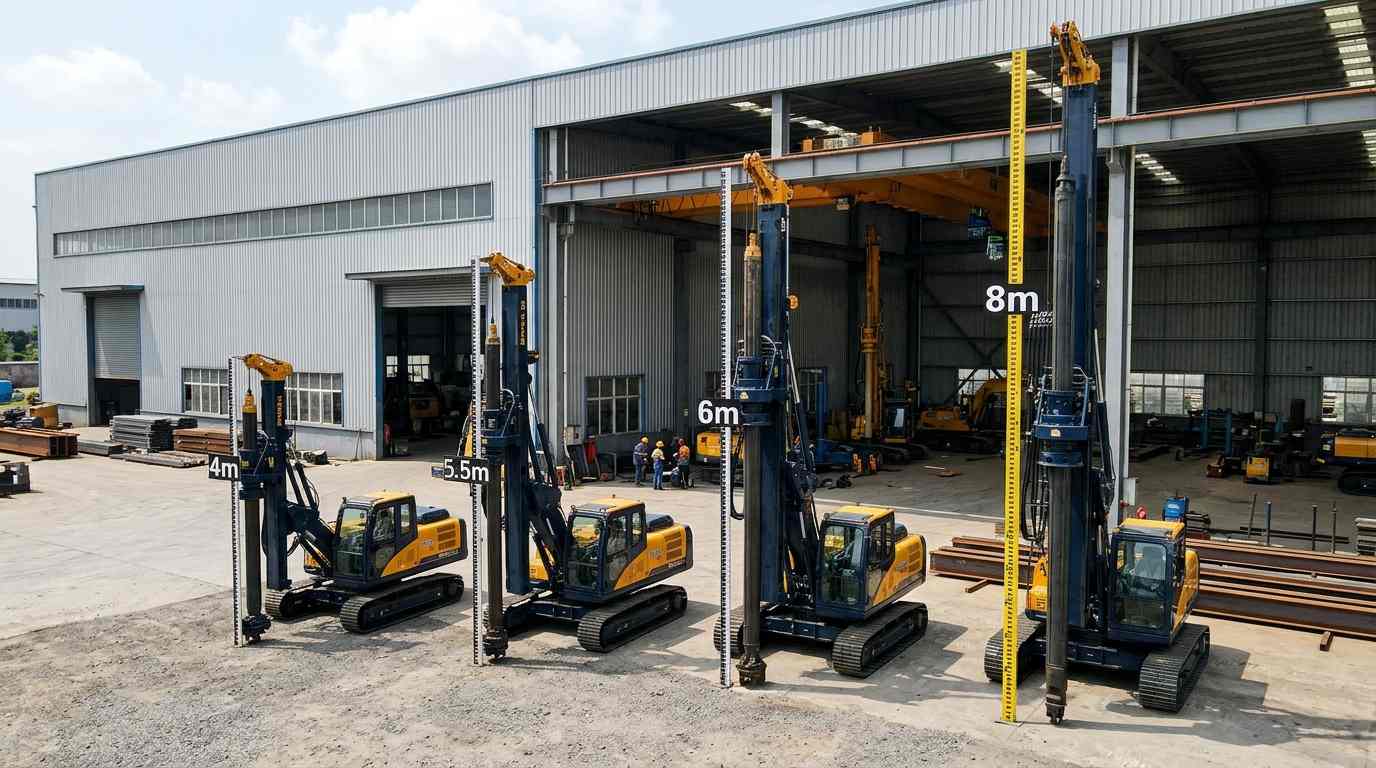
On our published spec sheets, 4.0 m piles go to the TZ585 (4,000 kg, 52 kW ChangChai), TZ539 (6,000 kg, 91 kW) or TZ630 (4,500 kg, 75 kW Cummins); 4.5 m goes to the TZ630; 5.5 m goes to the TZ536 (6,300 kg, 91 kW YuChai) or the wheeled TZ680 (7,200 kg, 20 km/h); 6.0 m goes to the TZ670 (6,800 kg, 91 kW); and 8.0 m goes to the TZ8000 (8,300 kg, 91 kW). The intelligent TZ650 handles 4.0 m with GPS and automatic levelling. Drilling depth is always shorter than driving height — 5.0 m on the TZ536, 5.5 m on the TZ670, 7.5 m on the TZ8000.
The short version: pick the mast travel that covers your longest pile, then check the drilling diameter, then decide whether you need tracks or wheels. Everything else is configurable.
|
4.0–8.0 m
Pile driving height across our standard models
|
30 working days
Listed lead time, MOQ 1 unit
|
500 units
Monthly production capacity
|
~50 / hour
Piles driven, ~400 per 8-hour day
|
It decides the mast, and the mast decides almost everything else. On the TZ536 the effective mast travel is 4.5 m with 1.0 m of compensation, which is how a machine with a 5.5 m driving height drills 5.0 m holes. On the TZ670 the effective travel goes to 6 m, so it drives 6 m piles and drills 5.5 m. On the TZ8000 the travel is 8 m, with 7.5 m drilling depth. Buy a machine whose mast is shorter than your longest post and you will be renting a second rig halfway through the job — that is the mistake we see most often.
Here is the range as published on our product pages. Drilling diameter differs by model, so we have kept each row as written on its own spec sheet.
| Model | Driving height | Drilling depth / diameter | Weight / engine |
|---|---|---|---|
| TZ585 (light crawler) | 4,000 mm | 3,500 mm / 50–300 mm | 4,000 kg / 52 kW ChangChai |
| TZ539 (crawler) | 4,000 mm | 3,500 mm / 50–400 mm | 6,000 kg / 91 kW |
| TZ630 (mast drive) | 4,500 mm | 4,000 mm / 50–300 mm | 4,500 kg / 75 kW Cummins |
| TZ650 (GPS, auto-levelling) | 4,000 mm | 50–300 mm | 5,000 kg / 75 kW Cummins 4BT3.9-C100 |
| TZ536 (crawler) | 5,500 mm | 5,000 mm / 50–400 mm | 6,300 kg / 91 kW YuChai |
| TZ670 (crawler) | 6,000 mm | 5,500 mm / 50–400 mm | 6,800 kg / 91 kW |
| TZ680 (wheeled) | 5,500 mm | 5,000 mm / 50–400 mm | 7,200 kg / YuChai 91 or Cummins 75 kW |
| TZ8000 (crawler) | 8,000 mm | 7,500 mm / 50–400 mm | 8,300 kg / 91 kW YuChai |
| TZ390 (roadside work) | 3,000 mm | 2,200 mm / 50–300 mm | 3,000 kg / 39 kW |
Source: the Technical Specification tables on each model's product page at tzpilemachine.com, plus the site's FAQ and service pages. Figures are as published; the signed configuration sheet is the final reference.
Four models sit at or near 4 m, and they are not variations of the same thing. The TZ585 is the light one at 4,000 kg, with a 52 kW ChangChai engine, a 105 L hydraulic tank and a 68 L fuel tank. Its work dimensions are 2,800 × 3,200 × 5,565 mm and it folds down to 2,800 × 2,400 × 2,650 mm for transport, which is why it gets specified for tight access and smaller ground-mount jobs. The TZ539 is much heavier at 6,000 kg and runs a 200 bar / 170 l/min hydraulic system — something you notice on harder ground, not on the spec sheet.
The TZ630 is the one with mast drive and roughly 100° of rotation. It uses a Cummins 75 kW engine, a single 63 ml/r pump at 180 bar, and its walking speed is 0–2.5 km/h. The TZ650 is different again: it is the intelligent unit, with an automatic control system, GPS and automatic levelling. Its spec sheet lists four satellite systems to choose from — GPS, GLONASS, GALILEO and Beidou — three ranging sensors, two attitude sensors, a tablet for setting the piling programme and full remote control. If your project is a highway job as much as a PV job, the TZ650 is listed under our guardrail category too, and the same plant builds dedicated highway guardrail installation driver units such as the TZ390, a 3,000 kg machine with a 3,950 mm guide rail, 1,280 J impact energy and 400–800 bpm.
Less than the model numbers suggest, and more than the price list shows. The TZ536 drives 5.5 m piles, drills 5.0 m holes, weighs 6,300 kg and runs a 91 kW YuChai engine through a double pump (63+32) at 200 bar and 170 l/min. Remote control is included as standard on that machine, and the integrated console is set up so one operator can run everything. Its hydraulic tank holds 105 L and the diesel tank 85 L. The cooling system has an enlarged radiator plus an auxiliary radiator, which our product page states allows operation at +50 °C.
The TZ670 takes the mast to 6 m and the drilling depth to 5.5 m. It weighs 6,800 kg, uses 140 L hydraulic and 140 L diesel tanks, and adds a few things operators actually care about: the mast shifts 150 mm left and right, the inner frame extends 50 cm horizontally, and the console has one-key levelling and resetting, a throttle knob, an emergency stop, and a switch between high/low speed and one-key piling mode. Remote control is optional here rather than standard — worth checking before you compare quotations. The TZ670's raised tracks are 300 mm wide, 2,300 mm long and 700 mm high.
The TZ680 is the wheeled alternative at the same 5.5 m driving height. It moves at up to 20 km/h, climbs 25°, and uses an electric control handle. Its hydraulic hammer is rated at 1,500 J single impact energy, higher than the 1,260 J listed for the crawler machines, and the spec sheet recommends 46# hydraulic oil with a 20 MPa main pump. Because it is wheeled, it carries a separate small air compressor, an air storage tank and spring brakes for the pneumatic braking system; the 120 L diesel tank is made of explosion-proof resin. Tanks are 168 L hydraulic / 120 L diesel. This is the machine for a large, flat, graded site where moving between rows eats the day.
Then it is the TZ8000, or a custom build. The TZ8000's spec sheet lists 8,000 mm driving height, 7,500 mm drilling depth, 50–400 mm diameter, 8,300 kg operating weight and work dimensions of 4,400 × 2,585 × 9,565 mm. It uses a 91 kW YuChai engine, 180 bar / 120 l/min hydraulics, 0–3 km/h travel, and the same 1,260 J hammer with a 1,460 J option. Like the TZ536, it comes with remote control and an integrated console, and its cooling package is rated for +50 °C.
The custom route is not unusual for us. In July 2024 a Russian customer needed an 8 m guide rail and could not find a stock machine; we extended the rail to handle piles up to 8.5 m, fitted a Cummins engine to Euro 5, and tested the machine before export. Our customization page lists the things that can be changed: engines of different brands and emission standards, hammer heads for different pile types, hydraulic hammers with different joule ratings, rotary heads with different torque, and masts of different heights. Send the drawing and the hammer cap can be made to match it. So the published 4.0–8.0 m range is a starting point, not a wall.
Three, mostly. Output, fuel, and the hammer. Our FAQ page states roughly 50 piles per hour and about 400 piles in an 8-hour day, with diesel consumption around 200 L over that shift. Those are the figures we publish; ground conditions move them, and we would rather say so up front than have a contractor discover it in week two. On hammers, the crawler machines list 1,260 J single impact energy at 450–900 bpm with a 440 kg working weight, and a 1,460 J option at 450–700 bpm with a 650 kg working weight. The wheeled TZ680 lists 1,500 J.
One honest note about our own pages: a few figures are written differently in different places. The TZ670 spec table says 91 kW while its feature text mentions a Yanmar 61 kW engine; the TZ585 header says 52 kW and its table says 53 kW; the TZ536 header lists 75/91 kW options while the table shows 91 kW. That usually reflects engine options and updates to the page rather than a different machine, but we tell buyers to confirm the engine brand, rated power and emission standard on the signed configuration sheet. If a quotation matters to your programme, get that sheet before the deposit.
Our product pages list pile driving and pulling, ground screw installation, auger drilling and down-the-hole drilling on the same platform. In August 2026, when a Saudi delegation came through the Suzhou plant to audit a 10-unit TZ536 order, the live demonstration covered three of those in one session: high-frequency hydraulic ramming, DTH rock drilling and rotary auger soil drilling. They had already visited several factories; the order was placed after that audit, and the machines shipped on 21 August 2026. Five more TZ536 units went to Laos on 7 May 2026, and a stock TZ536 for a Botswana customer was inspected, debugged and dispatched to Shanghai Port by 11 pm on 10 February 2026 to catch a booked vessel.
For the drilling side, the air supply matters. Our TZ550-15Y diesel screw compressor is published at 15 bar exhaust pressure, a Dongfeng Cummins QSB5.9-C190-31 engine rated 142 kW, a 150 L fuel tank, a maximum ambient temperature of 50 °C at sea level, a minimum operating temperature of −15 °C (−35 °C with cold-start assist) and a maximum operating altitude of 4,500 m. The drilling diameters on the piling machines — 50–300 mm on the smaller units, 50–400 mm on the 5.5 m and larger machines — are what you match against the socket or ground screw design.
Our pre-sales page describes the process as it actually runs: we ask about the project type (PV ground mount, road barrier work, bridge piles or something else), the terrain and topography, the construction plan and the programme. Then we recommend a model and explain which scenarios it suits, and our technical engineers answer the operating and maintenance questions. On complex projects we send sales and technical staff to the site. The single most useful thing you can attach is the pile schedule — longest post, diameter, wall thickness, and the geotechnical layers underneath it.
After the order, the after-sales page lists full-process production tracking with videos, photos and written records, a machine test including piling operations that can be shown over a live video call, and operation and maintenance training. The commercial terms published on the product pages are MOQ 1, 30 working days lead time, shipment from Shanghai or Qingdao, video outgoing-inspection provided, and a one-year whole-machine warranty. Our FAQ page adds 24-hour online technical staff, with on-site maintenance available for major issues, and payment by 100% L/C at sight or T/T. The company was established in 2010 in the Su-Xu High-tech Economic Development Zone in Suzhou, Anhui, holds CE and ISO9001 certification, and lists 3 invention patents, 38 utility model patents and 1 PCT international patent. Our About Us page describes the plant as the first Chinese manufacturer to develop and produce this class of machine; the FAQ page states 15 years of manufacturing experience. Both are the company's own wording, and we are happy to show the certificates behind them.
How many piles can one machine drive in a day?
Our FAQ page says about 50 piles per hour and roughly 400 piles in a normal 8-hour working day, with diesel consumption around 200 L for that shift. These are published figures, not a guarantee for every site — soil hardness, pile spacing between rows and repositioning time all change the number. For planning, ask us to relate them to your pile schedule and geotechnical report.
Can the hammer head be made for H-shaped, square or round piles?
Yes. The FAQ page states that the hammer head can be customized for H-shaped, C-shaped, square and round piles on both our PV and roadside machines. The customization page goes further: engines by brand and emission standard, different joule ratings on the hydraulic hammer, rotary heads with different torque, and different mast heights. Drill caps are made to the customer's drawing.
What is the lead time, warranty and payment structure?
Product pages list MOQ 1, a 30 working day lead time, shipping from Shanghai or Qingdao ports, video outgoing-inspection provided, and a one-year whole-machine warranty excluding wearing parts. Our FAQ page lists 100% L/C at sight or T/T, 24-hour online technical support and on-site maintenance for major repairs. A monthly capacity of 500 units is also stated there.
Which engines are fitted, and can the machines work in high ambient temperatures?
The published engines include a 52 kW ChangChai on the TZ585, a 75 kW Cummins on the TZ630 and a Cummins 4BT3.9-C100 (75 kW) on the TZ650, a 91 kW YuChai on the TZ536 and TZ8000, and YuChai 91 kW or Cummins 75 kW on the TZ680. The TZ536, TZ670, TZ680 and TZ8000 pages all describe an enlarged radiator plus an auxiliary radiator for operation at +50 °C. Engine brands and emission standards can be customized, so confirm the exact configuration in writing.



+8615061447755
 IPv6 network supported
Our hours
Whether it is a holiday or a festival, we will have someone to receive you 24 hours a day and respond to you in the shortest time.
Hi! Click one of our members below to chat on