EPC contractors often ask:
“Ground screws or helical piles — which should we use?”
The answer isn’t about which is better — it depends on site conditions, load requirements, and project constraints. Selecting the appropriate system affects installation speed, cost, and long-term stability. Understanding the differences between the two foundation types helps EPC teams plan more efficiently and avoid common pitfalls.
1. Understanding the Site Factors
Before comparing foundation systems, consider:
Soil type: uniform, mixed, gravel, or rocky layers
Load requirements: light solar structures vs heavy steel or industrial foundations
Site accessibility: can large rigs or equipment reach the area?
Project timeline: urgent vs flexible
These factors often determine the most suitable foundation type for a project, rather than the product alone.
2. Ground Screws: Fast, Efficient, and Reusable
Ground screws excel in flat land with uniform soil, especially for projects where speed and minimal disturbance are priorities.
Advantages:
No concrete → zero curing time
Fast installation → higher daily productivity
Minimal site disturbance → suitable for sensitive environments
Easy removal → reusable and sustainable
Best for: distributed solar, temporary or semi-permanent structures, fast-track projects.
3. Helical Piles: Reliable in Complex Soil
Helical piles provide stronger, deeper support where soil is mixed, rocky, or near bedrock. Their helix plates improve bearing capacity and settlement resistance.
Advantages:
Higher load capacity
Deeper penetration for stability
Predictable performance via torque monitoring
Reduced long-term settlement risk
Best for: uneven terrain, industrial foundations, high-load solar projects.
4. Torque Control: The Overlooked Key
Installation quality is critical. Even the best pile can underperform if torque isn’t controlled. Unstable torque can lead to:
Inaccurate bearing capacity
Uneven settlement
Difficulty verifying design requirements
Tezhong solution: stable torque output, controlled rotation, and real-time monitoring to ensure every pile meets engineering specifications.
5. Cost Perspective: Short-Term vs Long-Term
Ground screws save: installation time, labor, material → ideal for fast-track, budget-conscious projects
Helical piles save: rework, structural risk, long-term maintenance → ideal for complex, high-value projects
Equipment also matters — reliable machines reduce errors, improve speed, and ensure consistent quality, especially on small- to mid-size EPC projects or sites with limited access.
6. Choosing the Right Foundation
Quick guide for EPC teams:
Uniform soil + fast installation → Ground Screws
Mixed soil + high load → Helical Piles
When in doubt, perform a test installation with torque measurement to confirm performance.
Tezhong recommends: assess soil, define load, test torque, select the right system, and use stable, controlled equipment. This ensures every pile delivers real-world reliability and project success.
👉 Contact Tezhong to discuss your solar project and optimize your foundation solution.
Key Points Summary:
1. Soft soil projects may seem simple, but efficiency can vary significantly: Even under similar soil conditions, different equipment choices can lead to large differences in overall project progress.
2. Equipment stability determines construction efficiency:
Downforce control, hydraulic responsiveness, and continuous operation capability are key to maintaining high drilling efficiency.
3. Pursuing drilling speed too aggressively carries risks: Collapsing hole walls, accumulated drill debris, or misaligned holes can all reduce overall efficiency.
4. Three essential equipment selection criteria for soft soil projects: Stable continuous operation, minimal need for manual drilling correction, and a drilling pace that is not easily disrupted.
Conclusion: Choosing the right equipment matters more than merely chasing speed. Efficient and stable equipment can significantly reduce rework and improve overall construction progress in soft soil solar projects.
Introduction: Misconceptions about Soft Soil and Construction Efficiency
In many solar ground-mount projects, as soon as people hear "soft soil," "sandy soil," or "farmland," construction teams often breathe a sigh of relief.They assume, “No rocks, no blasting—drilling and pile driving should be smooth.”
But in reality, we often see a different scenario:Even in adjacent areas with almost identical soil conditions, drilling efficiency can vary by nearly double.Some areas progress smoothly, while others frequently stop or require adjustments, disrupting the overall project pace.
So, is it really just the soil?
Soft soil isn’t hard—but it does “test your equipment”
On paper, soft soil has natural advantages:
· Low resistance when drilling
· Smooth drill advancement
· Short drilling time per hole
However, soft soil also has a clear trait:Loose soil, uneven compaction, and varying conditions in backfilled areas.
In this type of terrain, the real efficiency gap isn’t about power—it’s about how consistently your equipment can perform throughout the project.
Why “drilling faster” can actually slow you down
This is a common pitfall in soft soil projects.
When drilling loose or backfilled soil, chasing speed can create problems like:
· Collapsing hole walls
· Accumulated debris requiring repeated clearing
· Misaligned holes that force rework
On the surface, it looks like “fast drilling,” but in reality, it becomes slow construction.
From multiple projects, we’ve consistently observed one conclusion:High efficiency in soft soil drilling comes from a stable pace, not maximum speed.
Even in soft soil, efficiency often starts with the equipment
Some equipment “can drill,” but it’s not optimized for long-term soft soil work, such as:
· Inconsistent downforce control
· Unsteady hydraulic response
· Reduced stability after several hours of continuous operation
A single hole may not reveal the problem, but when you’re drilling hundreds or thousands of holes, these small issues compound and slow the project down.
Solar projects are never about single-hole speed—they’re about batch drilling performance.
A practical rule: three quick checks for soft soil projects
From both manufacturer and field experience, we usually advise project teams to focus on three key questions:
1. Can the equipment maintain stable operation after 6–8 hours of continuous work?
2. Does drilling require frequent manual correction?
3. Can the equipment keep a steady pace when faced with backfill or local soil variations?
If all three are met, site drilling efficiency is usually strong, and overall project timelines become more predictable.
From a manufacturer’s perspective: soft soil needs the “right equipment”
As a long-term equipment supplier to solar EPCs and construction teams, Anhui Tezhong Machinery has noticed that in soft soil projects, the problem isn’t that the drill can’t penetrate—the problem is choosing the wrong equipment.
The most suitable equipment for soft soil usually has these traits:
· Stable output for long continuous operation
· Smooth control that reduces reliance on operator experience
· Mature design to handle variations in backfilled soil
These factors often determine actual efficiency far more than any spec sheet numbers.
What equipment works best for soft soil drilling?
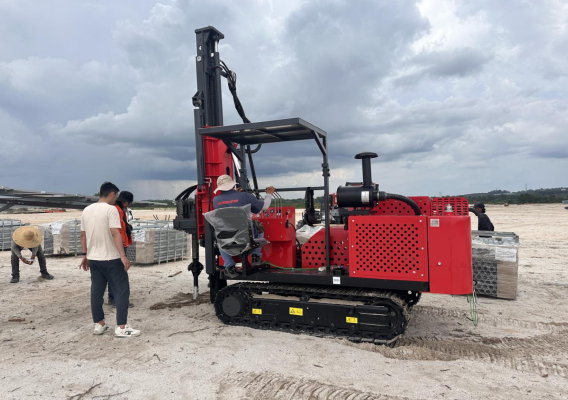
Take our widely used TZ539 drilling solution as an example. It’s not about looking powerful on paper—it’s designed to address the real challenges of soft soil and typical site conditions:
· Maintaining stable holes in loose soil layers
· Minimizing collapses and rework
· Allowing continuous, controlled drilling pace
Many clients don’t notice equipment differences at the start of a project. But once the site is running, it quickly becomes clear:Whether the equipment is “easy to work with” often determines the real drilling efficiency in soft soil projects.
Conclusion: efficiency is often decided the moment you choose your equipment
Soft soil gives solar projects a good starting point, but turning that advantage into progress and cost savings still depends on equipment choice.From our experience at Anhui Tezhong Machinery,the right drilling equipment for soft soil should make construction easier, not more dependent on luck or operator skill.
If you’re planning a solar project on soft soil—or facing inconsistent drilling efficiency and excessive rework—we can help you evaluate whether your current equipment is suitable and explore more efficient, stable solutions tailored to your soil conditions, pile types, and project pace.
Sometimes, choosing the right equipment is the most efficient solution itself.




 IPv6 network supported